How We Turn Retired Coffee Trees Into Export-Grade Dog Chews
Every coffee tree has a working life. After 20–25 years, a tree stops giving the yield a farm needs, and it comes out of the ground to make room for a new one — leaving behind a trunk most farms have no use for. In Gia Lai and Đắk Lắk, Vietnam’s coffee heartland, that used to mean firewood. We saw a chew toy instead.
That single insight, back in 2019, became a business that now ships 5–6 million units a year to 40+ countries. Here’s what actually happens between a retired coffee tree and a chew that clears customs in the EU or US.
Step 1: A Tree Retires, Not Gets Cut Down
We don’t buy standing coffee trees, and we don’t compete with farms for wood. A coffee tree gets pulled only when a farm has already decided to replant — usually because yield has dropped past the point of being worth another season. That decision belongs to the farmer, for farming reasons, before we’re ever involved. What we’re sourcing is the trunk and root wood that farm no longer has a use for.
This matters for a wholesale buyer because it means our raw material supply isn’t tied to a harvest calendar the way, say, a food byproduct might be — it’s tied to how many coffee farms in Gia Lai and Đắk Lắk are mid-replanting cycle in a given year, which is a much larger and steadier pool.
Step 2: Cut, Dried, Sanded — In That Order
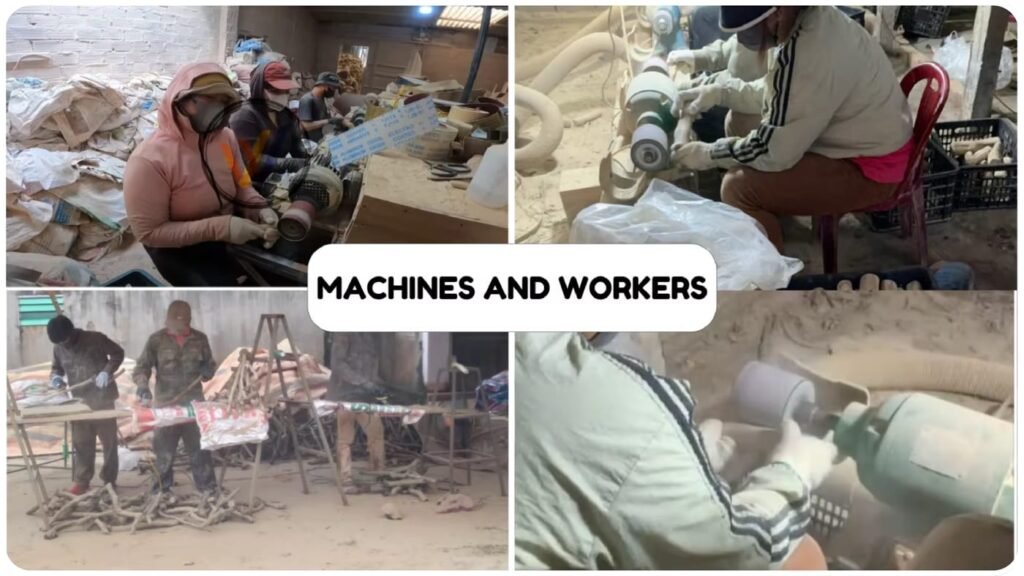
Raw trunk and root wood arrives at the factory floor and goes through the same three mechanical steps regardless of which product line it’s headed for: it’s cut to rough dimension, dried, then sanded smooth. Every piece is inspected by hand before it moves to packaging — not sampled, inspected. That’s also the point where a piece with an unacceptable flaw gets pulled, before it’s counted as a graded, sellable SKU.
We don’t coat, dye, or chemically treat the wood at any point in this process. What comes out the other end is sized into six grades for our core CC01 line — from a 35–45g XS bar up to a 325–450g XL — plus a denser “Gorilla” line (GRL) cut specifically from thicker roots and branches for stronger chewers.
Step 3: What “Export-Grade” Actually Means on Paper
A chew that’s cut, dried, and sanded well still isn’t export-ready without documentation. Every shipment we send carries three certificates: a Certificate of Origin (Form B, issued by VCCI Ho Chi Minh City), a Fumigation Certificate for Methyl Bromide treatment, and a Phytosanitary Certificate from Vietnam’s Plant Protection Department. That’s not paperwork we added recently — our first shipment on record cleared customs in Southampton, UK, in December 2021, under the same three certificates we still issue today.
For a buyer, this is the difference between a supplier who can produce a sample and a supplier who can actually get a container through customs on the date they promised.
Step 4: Scaling Without Losing the Batch
Going from a local answer to a waste problem to 5–6 million units a year didn’t happen by making the process less consistent — it happened by controlling for size and finish at each of the six CC01 grades, so a private-label buyer ordering 500 units gets the same spec as a buyer ordering a full container. We ship through 100+ freight forwarders worldwide at this point, from single-container test orders to standing wholesale accounts.
What This Means If You’re Sourcing
The practical entry point is a free sample (3 pieces, buyer covers courier) and a 50-unit minimum per item code, logo engraving included — low enough to test the line before committing to printed private-label packaging (500-unit minimum). Every line takes laser engraving or custom labels from 50 pieces. Full sizing, SKU codes, and the wood-plus-rope styles (CC02–CC15) are on our Coffee Wood product page; the fuller version of this story, including what we don’t claim about the material, is on Our Story.
Frequently Asked Questions
Where does WINVN source its coffee wood?
Gia Lai and Đắk Lắk provinces, Vietnam — from coffee trees aged 20–25 years that farms are already retiring for replanting.
Is the wood treated with any coating or chemicals?
No. It’s cut, dried, sanded, and quality-checked — no synthetic coating or dye at any stage.
What certificates ship with each order?
A Certificate of Origin (Form B, VCCI Ho Chi Minh City), a Fumigation Certificate, and a Phytosanitary Certificate, on every shipment.
How many countries has WINVN shipped to?
40+ countries, through more than 100 freight forwarders, as of 2026.
What’s the minimum order to try the product?
A free 3-piece sample (courier paid by the buyer), then 50 pieces per item code (logo engraving included), or 500 pieces if you need printed private-label packaging.
Want to see the material before you commit to a container? Request a wholesale quote — three product samples at no charge (courier paid by buyer).
Want the details behind this post?
Three product samples at no charge; courier charges apply. Sample availability and preparation time confirmed with your request. We reply with pricing and lead time, usually the same working day.
Request Wholesale Quote